Spatially explicit modeling of energy and matter fluxes in soils
Soil organic matter turnover and microbial metabolism are fundamentally driven by the acquisition and utilization of carbon, energy, nitrogen and further nutrients. Understanding how microbial processes respond to different energy and substrate conditions is therefore essential for revealing the mechanisms controlling soil carbon turnover and storage. This study focuses on the microscale dynamics of microbes interacting with different substrates, as well as the associated evolution of metabolic energy. Using a Cellular Automaton framework, a process-based model is developed to couple microbial activity with carbon, nutrients, energy as well as structural dynamics. The model includes local interactions of microbial consumption of organic carbon, nutrient uptake, degradation, and growth, while simultaneously representing the internal energy dynamics of the system. Based on this model, we investigate how different substrate conditions— characterized by varying energy content, stoichiometric properties, and spatial distributions—and connectivity impact energy dynamics, microbial community formation, and necromass accumulation.
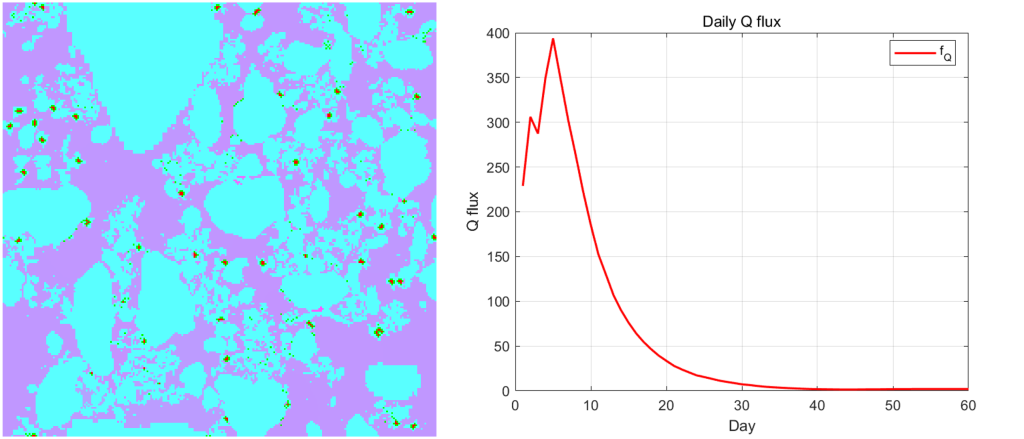
Heat is generated through microbial glucose uptake and respiration. In the absence of additional substrates, microbial biomass transiently increases before declining and forming particulate necromass (green), while white regions denote solid soil aggregates; the associated heat flux follows a similar temporal pattern.
Link to English scientific abstract
Link to German scientific abstract
Research Team
Project Leader
nadja.ray@ku.de
PhD student
chang.peng@ku.de
Katholische Universität Eichstätt-Ingolstadt (KU)
Mathematisches Institut für maschinelles Lernen und Data Science (MIDS)
Lehrstuhl für Geomatik und Geomathematik